01 Jun 2026
Ancient funeral discoveries bringing the past to life in Leeds
Ancient artefacts discovered inside a Bronze Age burial mound in Leeds are revealing fascinating insights about life and death in some of the city’s earliest communities.
Excavated during archaeological investigations on a modern-day housing project in Drighlington, the rare finds are believed to have been buried as part of funeral rituals carried out by local people around 4,000 years ago.
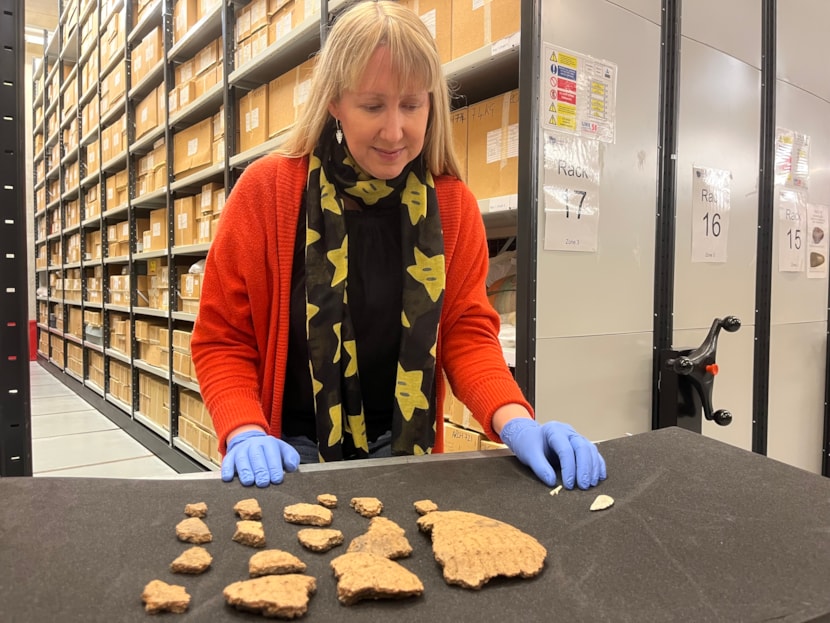
As well as the cremated remains of a child and three adults, the dig uncovered fragments of a decorated clay urn, part of a pin which was carefully carved from a piece of animal bone and the shattered blade of a delicately honed flint knife.
Both the human remains and the objects are now part of the growing archaeology collection at Leeds Discovery Centre, where they will be stored for important learning and research, with the urn, needle and knife also going on display to visitors later this year.
The historic discoveries were first made in 2020, when experts from Archaeological Services WYAS were called in to explore the site at Pitty Close Farm as it was being redeveloped for housing.
Their meticulous work exposed the partial remains of a barrow, a type of ancient, circular, monumental grave made by piling earth and stone to create a burial mound, often surrounded by a ring ditch.
Inside they found four cremation pits grouped together in an area of around two square metres, containing charcoal and the bones of three adults and a child aged between nine and 12. Radiocarbon dating showed the earliest of the cremations took place around 1889 -1701 BC.
Unusually, the remains of one individual were contained within the fragments of a collared urn, which together with the pin and knife indicated that the person may have been of high status in Early Bronze Age society.
The urn itself was decorated with a delicate twisted cord impression and a pattern which experts believe may have been made by hand with a cow-rib spatula.
The pin was burned as part of the funeral pyre along with the knife, which was made from flint not common in the area and which may have been a prized and valuable possession for its former owner.
Kat Baxter, Leeds Museums and Galleries’ curator of archaeology, said: “This is a fascinating discovery which gives us a glimpse into how some of the Early Bronze Age communities in Leeds lived and died.
“It’s during this time period that we see cremation, the use of urns and the building of circular monuments like barrows become more common methods of burial as people began to live in more permanent settlements.
“People were coming together as communities, clearly putting in a lot of effort and resources to respect and care for the people they laid to rest.
“These types of sites would most likely have become important places for those early communities, helping them to establish a connection to the area which they could then pass on to future generations.”
Artefacts and data from the dig will now be stored at Leeds Discovery Centre, where alongside other archives they can be used in exhibitions, learning and research, while also helping to build a detailed and continually evolving record of the city’s history.
David Williams, manager of the West Yorkshire Archaeology Advisory Service, said: “Discoveries of this nature demonstrate the value of modern developer-funded archaeology. Without the planning process, this extraordinary prehistoric monument would have been entirely lost.
“This site offers a fascinating glimpse into the past of a landscape very different to our own, and seeing these excavated objects move into the Leeds collection ensures that the story of Pitty Close Farm is preserved for the public."
A state-of-the-art storage facility as well as a visitor attraction, Leeds Discovery Centre houses archaeological archives from across Leeds Metropolitan District.
A selection of objects from Pitty Close Farm alongside others from the recently acquired East Leeds Orbital Archive is being prepared for display at the centre for visitors to see later this year.
Councillor Salma Arif, Leeds City Council’s executive member for economy, said: “It’s absolutely incredible to think that people were building communities and establishing roots in Leeds around 4,000 years ago.
“That fact alone gives us a sense of just how much history and heritage is all around us today and what an important and historic place this city is. It’s fantastic that we are able to be the custodians of this archive and that our visitors will have the chance to learn more about some of the people who, millennia ago, laid the foundations of the city we know today.”
Leeds Discovery Centre is open to the public for pre-booked tours and is a Give What You Can museum, where visitors are invited to donate to support the museum if they are able.
Donations can be made when booking a tour online, and with cash and coins in a donation box in reception.
For more details please visit: Visit Leeds Discovery Centre | Leeds Museums and Galleries | Days out and exhibitions
ENDS
Notes to editors:
West Yorkshire Archaeology Advisory Service is part of West Yorkshire Joint Services, which delivers a number of services on behalf of the five West Yorkshire local authorities of Bradford, Calderdale, Kirklees, Leeds and Wakefield.
For media enquiries contact:
Leeds City Council Communications team
communicationsteam@leeds.gov.uk