15 Jun 2026
Experts earn their stripes with iconic tiger TLC
It was once one of the animal kingdom’s most impressive apex predators and for generations has been the striped sentinel guarding the entrance to Leeds City Museum.
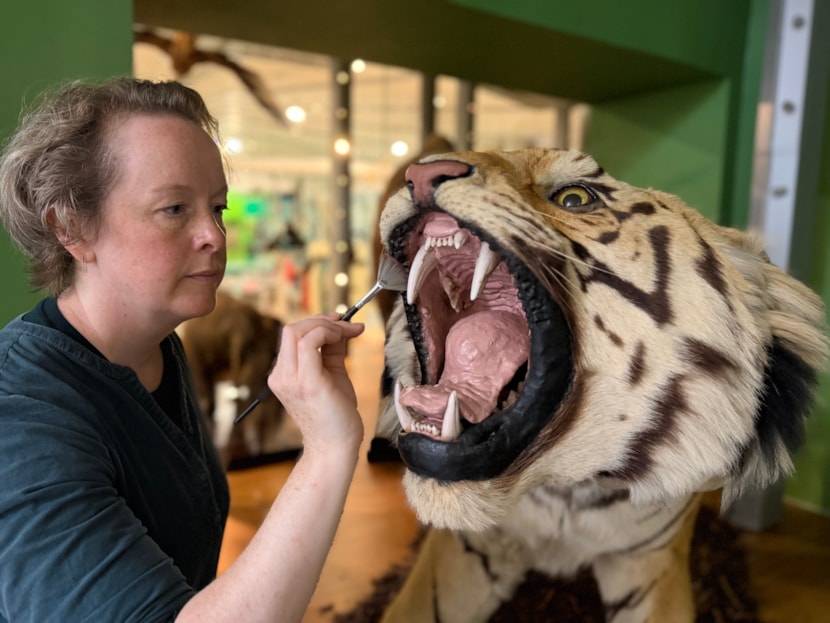
But an expert clean-up crew has discovered even the famous Leeds Tiger can fall prey to the passage of time and occasionally needs some careful pampering.
The gigantic Bengal tiger, thought to be one of the biggest taxidermy mounts of its kind anywhere in the world, was among a selection of the museum’s most precious and historic specimens being conserved in the museum’s spectacular Life on Earth Gallery.
Curators Clare Brown and Sarah Burhouse were on site carrying out meticulous checks for dust and the types of tiny pests which can be harmful to vintage taxidermy, before undertaking a delicate clean of some unique and historically significant exhibits.
A resident of Leeds for more than 160 years, the magnificent big cat was originally shot and killed in the foothills of the Himalayas by decorated soldier Major-General Sir Charles Reid in 1860.
He later boasted that it was the largest tiger he had ever seen, measuring more than 12 feet in length. Sadly, hunting tigers was a hugely popular pastime for British soldiers serving in colonial India, contributing to what was a catastrophic decline in the local population.
The animal’s pelt was subsequently shipped to the UK as a trophy and put on display in the Indian court of the London International Exhibition before being purchased by wealthy Leeds industrialist William Gott in 1862.
Gott then commissioned noted taxidermist Edwin Henry Ward to mount the tiger’s skin and presented the finished article for display by Leeds Philosophical and Literary Society, where it was hailed as “unequalled in Europe.”
As well as the tiger, conservation work included cleaning the delicate tail feathers of the museum’s incredibly rare pair of Huia, an extinct species of bird that once lived in New Zealand.
A sacred bird to the island nation’s indigenous Māori people, Huia tail feathers are traditionally only used and worn by people of great status and power.
In 1901, the Duke of York visited New Zealand and was gifted a Huia feather to wear in his hat. Unfortunately, the fashion statement led to a massive surge in demand for similar feathers, and Huai were hunted into extinction just six years later.
Also among the animals being checked over was giant panda Grandma. Named after being captured near Weizhou village in central China, she became the first live giant panda ever to arrive in the UK in 1938. She died just two weeks later after contracting double pneumonia.
Clare Brown, Leeds Museums and Galleries’ curator of natural sciences, said: “A great deal of our taxidermy collection dates from the late 19th and early 20th century, and because of the techniques used to preserve the mounts, as well as what they are made from, over time they can fall victim to pests, dust and shrinkage, where the skin dries out and can begin to crack.
“That’s why we need to carry out periodic monitoring like this to check for any noticeable changes to condition and to make sure pests aren’t causing any damage to these extremely rare and precious specimens.
“All of the animals we’ve been checking this week come from very different parts of the world and hugely varied habitats, but they’re all united by the fact their lives, and deaths were profoundly impacted by the intervention of humans into their environment.
“That’s one of the reasons taxidermy collections like ours are so important. Not only can these exhibits teach us about the past, they’re also an invaluable source of learning and research into how we can protect and preserve vulnerable species in the future.”
The Life on Earth Gallery is home to a vast collection of taxidermy which also includes a polar bear, turtle, sea lion, a Tibetan yak and the skeleton of a huge bluefin tuna.
The collection is displayed alongside information on the climate emergency and in-depth histories and stories of some of the museum’s amazing natural science objects.
Councillor Salma Arif, Leeds City Council’s executive member for economy, said: “The Leeds collection is truly extraordinary and filled with a spectacular array of artefacts, specimens and stories which can be seen nowhere else in the world.
“It’s thanks to the diligence and dedication of our teams working behind the scenes that this collection is preserved and conserved so it can continue to engage and inspire visitors for generations to come.”
Leeds City Museum is a Give What You Can museum, where visitors are invited to donate to support the museum if they are able.
Donations can be made via Tap to Give donations points on arrival or during your visit with contactless, Chip and Pin, cash and coins.
More details on planning your visit, can be found at: Leeds City Museum | Leeds Museums and Galleries | Days out and exhibitions
ENDS
For media enquiries contact:
Leeds City Council Communications team
communicationsteam@leeds.gov.uk