02 Jan 2026
Library’s timeless tome reveals daring royal rescue bid
An audacious bid to rescue King Charles I from imprisonment in Leeds is among the timeless tales discovered amid the pages of the city’s earliest written history.
The remarkable plot, told for what is believed to be the very first time within the centuries-old text, saw the notorious monarch offered a chance of escape from Red Hall in the city centre in 1647 by donning women’s clothes, which he politely declined.
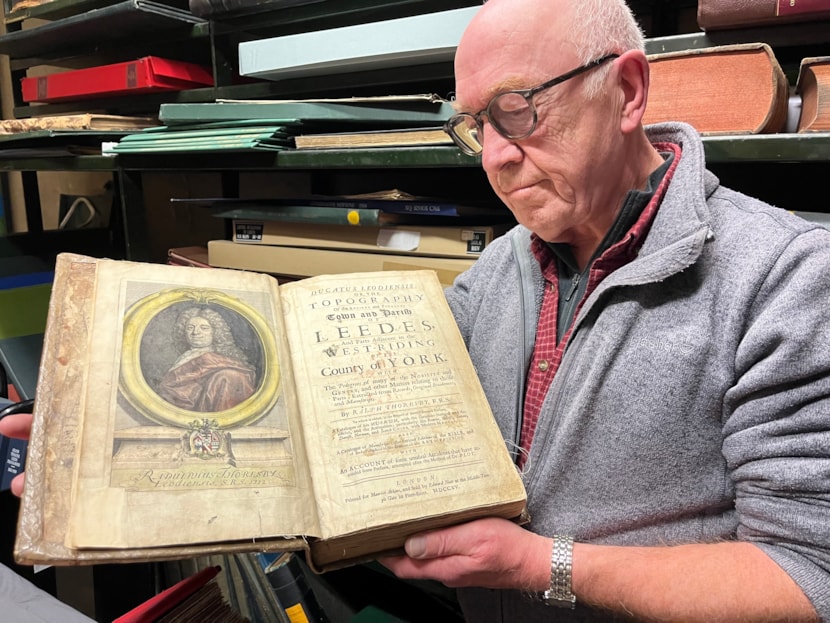
The fascinating story from the days of the English Civil War is relayed in a series of handwritten notes, scrawled in the margins of Leeds Central Library’s one-of-a-kind edition of famed historian Ralph Thoresby’s Ducatus Leodiensis.
Printed in the mid-1740s, the incredible book will be on display at the library until the end of January, 2026.
The lengthy series of unique annotations it contains were added by Thoresby’s contemporary and fellow antiquarian Thomas Wilson, and capture what is believed to be the first ever written record of the astonishing historical anecdote.
According to the notes, it was Mrs Crosby, a servant of wool merchant Thomas Metcalf, who offered to provide the disguise to the ill-fated King.
The cunning ruse would then have seen Mrs Crosby lead Charles I out of a garden door on Lands Lane under cover of darkness before leaving Leeds and his captors behind.
Although The King refused, he nevertheless handed Mrs Crosby his garter as a gesture of thanks, telling her that if his son ever came to the throne, she was to give it to him and tell the tale of how she came by it.
Sure enough, when King Charles II later came to power years after his father’s execution in 1649, Mrs Crosby presented him with the garter. Her husband was subsequently appointed to the prestigious position High Bailiff of Yorkshire as a reward.
The city’s brief encounter with one of English history’s most notable figures makes for a captivating addition to Thoresby’s already impressive work.
First published in 1715, the Ducatus Leodiensis; or the Topography of the antient and populous Town and Parish of Leedes and parts adjacent in the West Riding of the County of York to give it its full title, was by far the most detailed record of its kind and is filled with family trees, heraldic symbols of notable families and beautiful drawings of locations such as Kirkstall Abbey.
Widely regarded as the city’s first historian and the son of a merchant, Thoresby dedicated a large portion of his life to the study and collection of the history of his home city.
Antony Ramm, Leeds Central Library’s special collections librarian, said: “Before Thoresby set to work on the Ducatus, Leeds was of course already a city steeped in history.
“But his exhaustive research and irrepressible dedication to compiling such a comprehensive record of the city’s heritage may well have prevented many of these fascinating events and stories being lost in time.
“Thoresby’s work was also the spark which inspired generations of fellow historians to follow in his footsteps and create their own bigger, and even more elaborate histories, in turn ensuring an ever-evolving record of the city’s story was captured through the ages.”
Among those esteemed historians subsequently inspired by Thoresby was William Boyne, who compiled his own vast History of Leeds in the 1800s.
The culmination of his life’s work, Boyne’s collection of seven huge folios is also part of the library’s collection and includes magnificent images of locations including Temple Newsam and Kirkstall Abbey, genealogies, notable antiquities, coats of arms and maps of the city.
Councillor Asghar Khan, Leeds City Council’s executive member for communities, customer services and community safety, said: “Seeing the city’s early history laid out in such impressive fashion on the pages of these remarkable books brings home just how prestigious the story of Leeds really is.
“We’re extremely fortunate to have such a comprehensive archive of the city’s story which will be preserved for future generations.”
Thoresby’s Ducatus Leodiensis will be on display in the local and family history section of Leeds Central Library.
More information about Leeds Central Library including facilities and opening hours can be found at: Central Library | Leeds Library
ENDS
For media enquiries contact:
Leeds City Council Communications team
communicationsteam@leeds.gov.uk